This guide is for anyone choosing a home for themselves or their family, a second home, a rental property or a place to invest part of their money. It compares buying now, renting temporarily, waiting and selling, taking account of what each choice means for your life and budget.
As of 24 October 2026. The chart shows provisional home prices through the second quarter of 2026 and the European Central Bank’s key interest rates through 13 October 2026. The inflation assessment comes from its monetary policy account published on 8 October.
When might home prices fall in the South of France?
There is no reliable date for a general fall in home prices across the South of France. Provisional notaries’ and French National Institute of Statistics and Economic Studies indices for Provence-Alpes-Côte d’Azur show house prices down 0.9% over the year to the second quarter of 2026 while apartments rose 1.3%. These series cover the region’s coast and inland areas, not the whole South or Monaco, and predate September’s rate rise. To decide whether to wait, track completed sales of comparable homes in your chosen area over several periods, allowing for publication delays, and set a review date that fits your housing need and budget rather than assuming a market-wide deadline.
As of 24 October 2026, the combination of two policy rate increases, inflation risks and more expensive mortgages makes weakening mortgage-dependent demand a particularly important scenario for buyers and sellers. It is a reason to examine local transactions and the terms of a particular property. Further rate increases remain a scenario; stronger demand or limited supply could change the direction of prices.
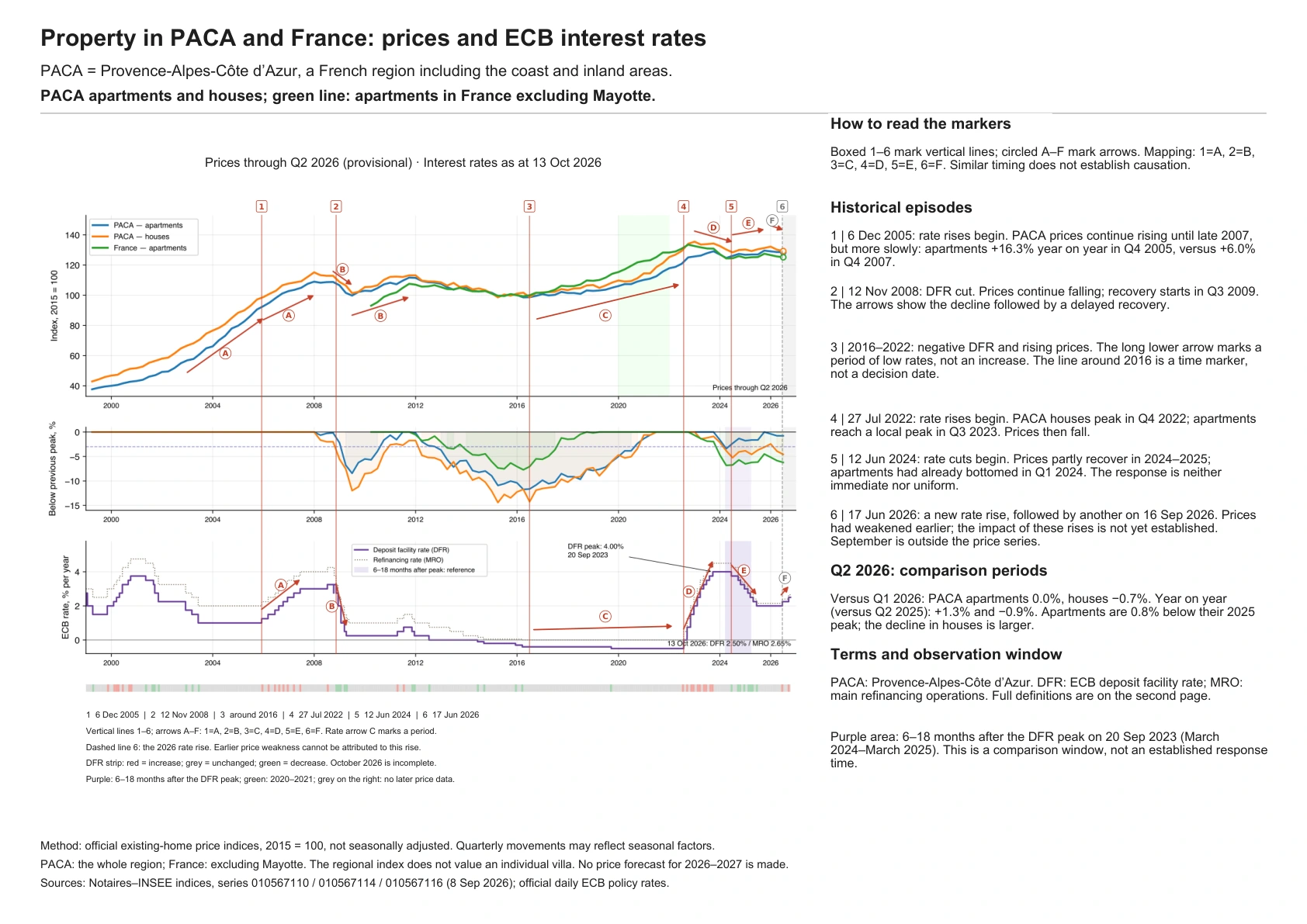
The top panel shows existing-home price levels, the middle panel the distance below the previous high, and the bottom panel European Central Bank rates. Blue lines represent apartments in Provence-Alpes-Côte d’Azur, orange lines houses in the same region, and green lines apartments in France excluding Mayotte.
PACA means Provence-Alpes-Côte d’Azur, a region of France. It covers the whole region, including inland areas. Its index cannot be applied directly to a particular coastal villa or to Monaco.
The regional apartment and house series run from the first quarter of 1999 to the second quarter of 2026; the series for apartments in France excluding Mayotte runs from the first quarter of 2010 to the second quarter of 2026. The national line provides a comparison. The tables of cycle lengths and delays below are calculated from the two regional series.
- The index measures price changes while accounting for the characteristics of homes. The model used by French notaries and the national statistics institute accounts for differences between the properties sold. It measures changes in the price of comparable housing, rather than an average or median price or a price per square metre. The average index value for 2015 is set to 100. The chart data are not seasonally adjusted; below, we also compare annual growth rates and a smoothed series.
- Zero in the middle panel means a high reached by that date. It does not mean zero annual growth. A value of −5% means prices are 5% below the previous high.
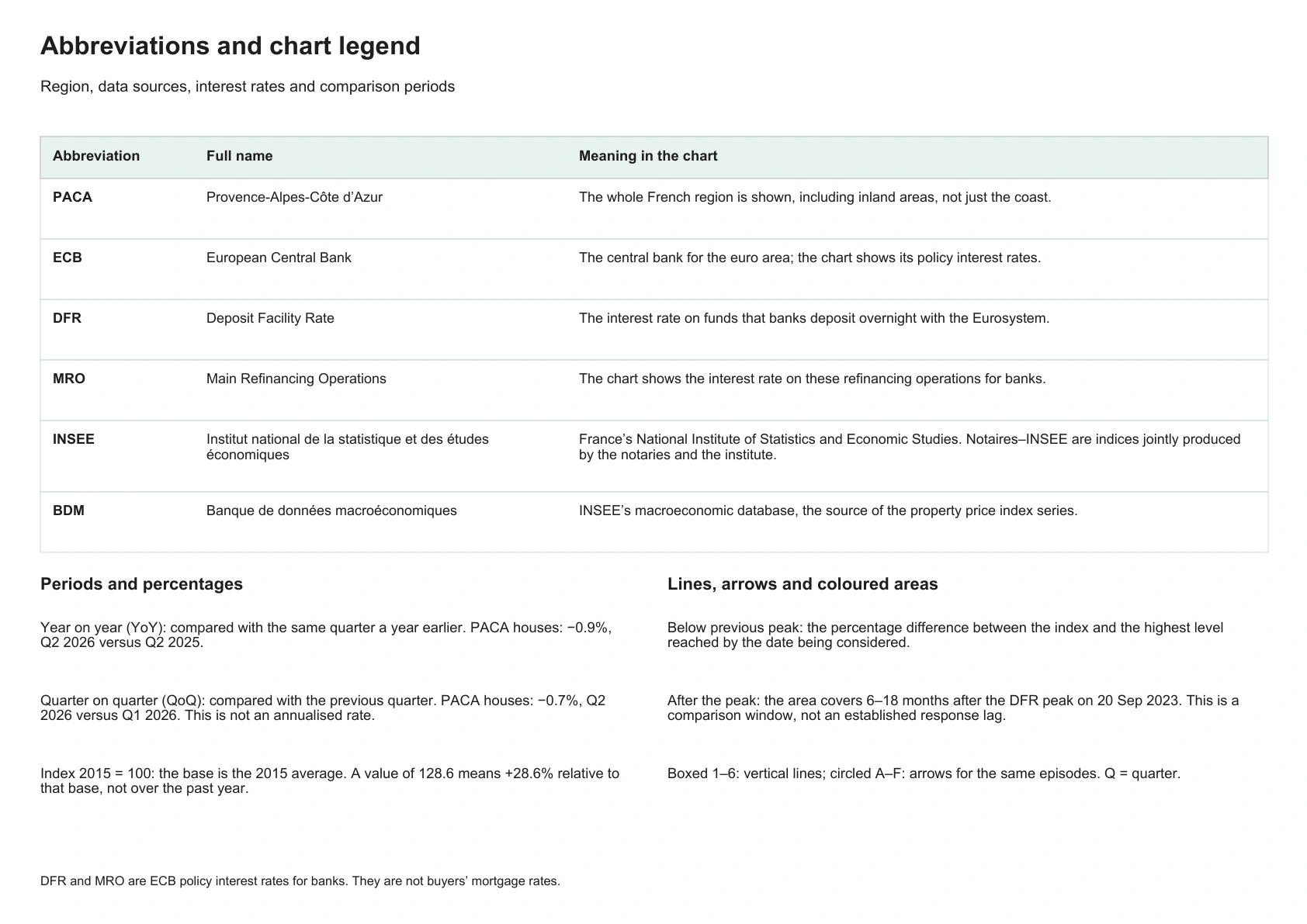
- The bottom panel shows the European Central Bank’s key interest rates. Mortgage rates—the terms on which buyers borrow to purchase homes—are not plotted in this panel. DFR is the deposit facility rate paid on banks’ deposits with the European Central Bank. MRO is the rate on its main refinancing operations, through which it lends funds to banks.
- The coloured areas mark time periods. Purple highlights 6–18 months after the deposit rate peak on 20 September 2023: a selected comparison window, rather than an established time lag in house prices. Green highlights 2020–2021. Grey on the right marks a period for which price observations are not yet available.
- The strip below the rates shows changes in direction: red means a rise in the deposit rate, green a cut, and grey no change. October 2026 is incomplete.
Explanation of the chart’s labels
How much could home prices fall in the South of France?
No reliable percentage forecast applies to every home in the South of France. Between the fourth quarter of 2007 and the second quarter of 2009, the Provence-Alpes-Côte d’Azur apartment index fell 8.4% and the house index 12.0%: historical observations, not a future forecast or a discount to subtract from a listing. For your purchase, use recent completed sales of comparable local homes, then test affordability with falling, unchanged and rising prices. An expected reduction is not money already saved; a cut in an asking price may merely correct an excessive starting price.
More recent episodes had different sizes: Provence-Alpes-Côte d’Azur apartments lost 3.4% from their local peak in the third quarter of 2023 to the first quarter of 2024, while houses lost 5.2% from the fourth quarter of 2022 to the second quarter of 2024. The periods and property types differ. These figures are not a forecast range; some correction may also already be reflected in an individual asking price.
For a future purchase, test several scenarios, including no price decline and rising prices. Do not automatically deduct a historical percentage from an asking price: supply, property condition and sellers’ circumstances differ from one location to another.
How can I tell whether home prices in the South of France have already started to fall?
Check for lower completed-sale prices for comparable homes in your chosen part of the South of France over several periods, allowing for seasonality and publication delays. An index adjusting for property characteristics is more informative than a simple average that can fall because cheaper homes sold. In the second quarter of 2026, Provence-Alpes-Côte d’Azur house prices were down 0.9% annually while apartments rose 1.3%: these observations do not establish a general decline and are too early to show September’s rate rise. Listing cuts and longer selling times are supporting signals, not prices actually paid; a withdrawn listing does not prove a sale, and slower price growth is not yet a fall.
First separate apartments from houses, then select a comparable area and period. Allow for seasonality in indices and, in individual transactions, differences in floor area, condition, land and location. An asking price shows the seller’s expectations; a recorded transaction price shows the outcome of negotiations. A decline in one indicator cannot automatically be applied to the whole South of France.
In the research below, a slowdown means two consecutive decreases in the annual growth rate. A move into annual decline means two consecutive quarters below the same quarters of the previous year. These are different signals: prices may still be rising, but more slowly. This method identifies a movement with a delay, once the data are available.
Can homes in France keep getting more expensive even when mortgages cost more?
Homes in France can keep rising in price despite dearer mortgages where demand remains strong, suitable properties are scarce or buyers can pay without borrowing. Previously arranged sales may also delay the price response. This is a possibility, not a forecast, and differs by location and property type: compare completed local sales and reassess your financing before assuming waiting will bring a cheaper home. Higher resale prices do not necessarily mean a net gain after acquisition and selling costs, work and applicable taxes.
More expensive mortgages gradually reduce the amount some buyers can offer. However, not every buyer borrows, not every seller is ready to accept less, and previously arranged transactions are still completing. A local shortage of suitable homes may support prices.
The historical chart compares prices with the European Central Bank’s key interest rates. These are banking benchmarks. Mortgage rates are the terms on which buyers borrow for housing; banks set them according to funding costs, risk and the mix of loans they make. The series are related, but they are not identical and do not automatically move by the same amount.
The following is a chronological explanation of the six chart markers, together with calculations for earlier periods. It helps assess how long a response might take, but does not set a date for a future purchase or sale.
The Provence-Alpes-Côte d’Azur chart shows a sequence: growth during falling and low interest rates, slowing growth after rates rise, a delayed price peak and decline, then recovery. This history also contains periods when low rates were not enough to make prices rise.
Marker 1 · arrows A · 2005–2008
In Provence-Alpes-Côte d’Azur, prices continued to rise after the first rate increase on 6 December 2005 until the end of 2007, but growth slowed. This is observed price inertia: the change in financing conditions and the reversal in transactions being completed did not happen at the same time.
Before marker 1, interest rates fell and then remained at their minimum from June 2003 while prices rose. After marker 1, apartments continued to become more expensive, but annual growth slowed from 16.3% in the fourth quarter of 2005 to 6.0% in the fourth quarter of 2007. Apartments and houses peaked in the fourth quarter of 2007, then prices began to fall. Continued index growth early in a rate-rise cycle therefore does not necessarily mean demand is as strong as before.
Marker 2 · arrows B · 2008–2016
A recovery in apartment and house prices in Provence-Alpes-Côte d’Azur became visible from the third quarter of 2009. After the rate cut marked on 12 November 2008, prices continued falling until the second quarter of 2009: prices also responded with a delay when financing conditions eased.
Marker 2 shows one of the cuts; the easing cycle had begun earlier, in October 2008. Between the peak in the fourth quarter of 2007 and the second quarter of 2009, apartments lost about 8.4% and houses 12.0%.
The whole stretch up to marker 3 is not uniform. After the 2009–2011 recovery, the European Central Bank raised rates twice, in April and July 2011. Apartments reached a local peak in the third quarter of 2011, and houses in the third and fourth quarters. Prices then weakened for several years, even though rates began falling again in late 2011. Low rates support demand, but cannot ensure price growth on their own.
Marker 3 · arrow C · 2016–2022
Between 2016 and 2022, apartment and house prices in Provence-Alpes-Côte d’Azur rose during a prolonged period of low interest rates. Financing conditions supported purchasing power, but the chart cannot separate their contribution from changes in incomes, supply and buyers’ preferences.
The marker around 2016 is a reference point in time, not the exact date of a central bank decision. The deposit facility rate became negative in 2014, and the main refinancing rate reached zero in March 2016. The long lower arrow C indicates the duration of this period. Its slope does not indicate a rate increase. House price growth accelerated particularly noticeably towards the end of the period.
Marker 4 · arrow D · 2022–2024
After the first rate increase on 27 July 2022, house prices in Provence-Alpes-Côte d’Azur peaked in the fourth quarter of 2022, while apartments peaked in the third quarter of 2023. Houses turned down earlier; apartments continued rising for about another year.
From its peak to the subsequent low in the second quarter of 2024, the house index fell by 5.2%. The apartment index fell by 3.4% from its local peak in the third quarter of 2023 to the first quarter of 2024. The timing and size of the declines differ even within one region. They do not provide a ready-made discount for an individual property.
Marker 5 · arrow E · 2024–2026
In 2024–2025, the recovery in Provence-Alpes-Côte d’Azur prices varied by property type: apartments exceeded their previous local high in the third quarter of 2025, while houses remained below their late-2022 peak. Apartments had already passed their low before the first rate cut on 12 June 2024.
By the second quarter of 2026, apartments were about 0.8% below their third-quarter 2025 high and houses were 4.6% below their fourth-quarter 2022 high. It would therefore be premature to describe this whole period as a new, sustained upswing: the recovery differed by property type and had already weakened by early 2026.
Marker 6 · arrow F · 2026
Two European Central Bank rate increases followed by more expensive French mortgages increase the risk of weakening demand in segments dependent on borrowing. For buyers, this is a reason to recalculate their budget and negotiating position. The price chart through the second quarter of 2026 does not yet show any response to September’s rate rise.
The increases took effect on 17 June and 16 September 2026, taking the deposit facility rate from 2.00% to 2.50%. In its account of the September meeting, published on 8 October, the European Central Bank highlighted risks of higher inflation, including energy and geopolitical shocks. This weakens the case for expecting a rapid return to cheap credit, although it does not predetermine the bank’s next decision.
According to the study by Crédit Logement and the market and opinion research institute CSA, the average rate on housing loans in France’s competitive lending sector rose from 3.25% in June to 3.40% in September 2026. This is a nominal rate excluding insurance and loan security costs, rather than the full cost of borrowing or a personal offer to a foreign non-resident. Banks’ rates also respond to funding costs, risk and the mix of new loans.
An existing fixed-rate loan keeps its agreed interest rate during repayment: a policy rate rise does not automatically reset it. A new loan or renegotiation needs new terms. The Banque de France definition of a fixed-rate loan.
The period of rate cuts from June 2024, followed by the time spent at the resulting minimum until June 2026, lasted about two years; the minimum itself lasted about one year. This short period of easier financing makes the possibility of a rapid cooling particularly relevant. However, the price series still ends just as the new rate increases begin.
The following comparison examines the length of low key interest rate periods and subsequent price growth in Provence-Alpes-Côte d’Azur.
The 2005 and 2011 cycles are consistent with the proposition that prices kept rising longer after a longer period of low key interest rates. In Provence-Alpes-Côte d’Azur, after about 30 months at the rate minimum, prices peaked eight quarters after the first increase; after 23–24 months, they peaked after one to two quarters. The 2022 cycle shows that the duration of low rates alone does not determine the delay: despite a longer period of cheap money, houses turned down more quickly.
We tested this using the numerical series behind the chart. Initially, we defined the “low-rate period” identically for all cycles: the uninterrupted time each rate spent at its final minimum before the first increase. This is the minimum within that particular cycle: for example, 2% in 2025–2026 and a negative rate before 2022 do not mean equally cheap credit.
Time spent at the minimum policy rate and the subsequent peak in existing-home prices in Provence-Alpes-Côte d’Azur
| First rate increase | Deposit rate at its minimum | Main refinancing rate at its minimum | Apartment peak / delay | House peak / delay |
|---|---|---|---|---|
| 6 December 2005 | From 6 June 2003; 30.0 months | From 6 June 2003; 30.0 months | Fourth quarter 2007; 8 quarters | Fourth quarter 2007; 8 quarters |
| 13 April 2011 | From 8 April 2009; 24.1 months | From 13 May 2009; 23.0 months | Third quarter 2011; 1 quarter | Third–fourth quarters 2011; 1–2 quarters |
| 27 July 2022 | From 18 September 2019; 34.3 months | From 16 March 2016; 76.4 months | Third quarter 2023; 4 quarters | Fourth quarter 2022; 1 quarter |
| 17 June 2026 | From 11 June 2025; 12.2 months | From 11 June 2025; 12.2 months | Subsequent response cannot yet be measured: prices end in the second quarter of 2026. | Subsequent response cannot yet be measured: prices end in the second quarter of 2026. |
The delay is the difference between quarter numbers, not an exact number of months from the central bank’s decision to a transaction. In 2011, the house index was the same in the third and fourth quarters; the calculation uses the fourth quarter as the end of the peak. Sources: the original French notaries and national statistics institute indices and the official rate history; calculations by IMMO BTC.
What the comparison shows. The shorter low-rate period before the 2011 increase was followed by a faster reversal than the period before the 2005 increase. For apartments, the longer period before 2022 was also followed by a longer delay than in 2011: four quarters rather than one.
What else needs to be considered. Rates remained low for longer before 2022 than before 2005, yet apartments peaked after four quarters rather than eight, and houses after one rather than eight. The length of the previous period alone therefore cannot determine the timing of a future reversal.
The strength of the subsequent tightening also differed. The maximum increase in the deposit facility rate relative to its pre-cycle level during the first 12 months was 1.25 percentage points in the 2005 cycle, 0.50 in the 2011 cycle and 4.00 in the 2022 cycle. In 2011, increases soon gave way to cuts. This shows why the duration of cheap credit should be considered alongside the speed and persistence of subsequent increases in its cost. This calculation does not isolate each factor’s individual contribution.
The table measures the interval up to the price peak. A peak, the first quarterly decline and a move into year-on-year decline occur at different times. These intervals must not be presented as the time until a future price fall. They become known only after later observations are available.
In the 2005, 2011 and 2022 cycles compared here, two consecutive slowdowns in annual apartment and house price growth in Provence-Alpes-Côte d’Azur began in the quarter of the first rate increase or within the next one or two quarters. Prices could still be rising: slower growth and a decline in price levels are different stages.
Slowing growth and a move into annual decline: apartments / houses in Provence-Alpes-Côte d’Azur
| Rate-rise cycle | First consecutive slowdown recorded from the start of rate increases | First sustained year-on-year decline |
|---|---|---|
| 2005 | First quarter 2006 / second quarter 2006; after 1 / 2 quarters | Fourth quarter 2008 / fourth quarter 2008; after 12 / 12 quarters |
| 2011 | Third quarter 2011 / second quarter 2011; after 1 / 0 quarters | Second quarter 2012 / first quarter 2012; after 4 / 3 quarters |
| 2022 | Fourth quarter 2022 / fourth quarter 2022; after 1 / 1 quarter | First quarter 2024 / fourth quarter 2023; after 6 / 5 quarters |
Here, the start of consecutive slowing is the first of two successive quarters in which the annual growth rate is lower than in the previous quarter; the search begins in the quarter of the first rate increase. This does not establish the earliest onset of cooling: growth may have slowed before that quarter. Annual decline means the first of two consecutive quarters with a negative change relative to the same quarter a year earlier. This test records a price response; it does not measure the number of transactions.
Practical implication: waiting for the annual index to turn negative before recognising a cooling market means noticing it late. In these episodes, several quarters passed between weakening growth and annual price declines.
Research data and calculations
Underlying data. The research uses quarterly existing-home price indices for Provence-Alpes-Côte d’Azur and daily European Central Bank rates saved on 13 October 2026. Prices are not seasonally adjusted; the base is 2015 = 100. Annual change is calculated as (current-quarter index / index for the same quarter of the previous year − 1) × 100. Duration in months equals the number of calendar days / 365.2425 × 12.
Choice of episodes. The starts of rate increases in 1999, 2005, 2011, 2022 and 2026 were examined. The main comparison uses three episodes followed by an observed price reversal. In 1999, the final rate minimum lasted about 6.9 months, but the corresponding price reversal under the selected rule was not observed before the next rate-rise cycle in 2005. This must not be treated as a zero delay or omitted as though the episode had never occurred. Subsequent history is not yet available for 2026. The chart begins in 1999; earlier European monetary policy history was not examined here.
Rule for identifying a price peak. In each episode, we look for the first local maximum after the first rate increase followed by two quarters below that maximum and a fall of at least 2% within the following four quarters. The search ends when the next rate-rise cycle begins. If the maximum repeats, the last quarter is used. This uniform descriptive rule distinguishes a reversal from a small seasonal fluctuation; it does not date the precise day when market demand changed. Peaks are identified retrospectively: during the peak quarter, the later values confirming the reversal were still unknown. This calculation is not a tested trading strategy that enables an investor to sell precisely at the top in advance.
A broader measure of duration. If we count the entire period from the start of the preceding cuts to the next increase, instead of just the minimum-rate plateau, the durations are about 54.9 months before 2005, 29.9 before 2011 and 128.6 before 2022. This measures easing followed by time at low rates, rather than low rates alone. The 2005/2011 comparison remains consistent with greater price inertia after a longer period; the 2022 cycle still prevents us from treating it as a universal rule.
Checking the effect of seasonality. We also identified the first peak in the average index over the previous four quarters followed by two successive decreases in that average. Delays for apartments / houses were 11 / 11 quarters after 2005, 3 / 2 after 2011, and 5 / 4 after 2022. Smoothing itself adds a delay, so these figures do not replace the dates of the original peaks. However, the comparison’s result remains: the longest preceding low-rate period did not produce the longest price inertia.
Limits of the findings. Three completed episodes do not provide a reliable probability estimate for a future decline or a formula for its timing. Apartments and houses in the same region are not independent economic cycles. The effects of incomes, lending restrictions, supply, crises and expectations have not been separated; transaction numbers and time to sell have not been studied. The calculation tests the sequence of events and helps refine a working scenario.
Comparability with the original article. The chart uses original indices without seasonal adjustment. Some quarterly changes in the original article use seasonally adjusted series. They must not be mixed in a single calculation, nor should the difference be taken as an error in the source.
Should I buy a home in France now or wait?
Buying a home in France now can be sensible if the location and intended use suit your longer-term plans, comparable sales support the price, and purchase costs, work and ongoing expenses leave a cash reserve. Waiting may be preferable if your area, length of stay or financing remain uncertain. Compare both at the same future date: housing costs along the way, remaining savings and the home’s value after outstanding debt. Test unchanged or rising prices as well as a decline, and set a review date. Neither buying nor postponing should make your plans depend on finding the market bottom or leave you unable to cover essential costs.
Start with your purpose and timescale: a main home, a second home, letting or investing part of your money. For a foreign buyer, the currency of income and savings, financing terms and tax position also matter. The table brings together circumstances that could change a decision about a particular property.
Checking a decision about a particular property in France
| Circumstance | What to check, and where | How it changes the decision |
|---|---|---|
| Purpose of the purchase and personal timing | The buyer or owner determines the moving date, family needs, the role of a second home, desired income and need for available cash. | Whether waiting is possible and what it costs in money and quality of life. |
| Price within its location and category | Comparable completed sales: notarial data and the public database of transaction prices. Allow for property type, land, condition and the immediate location. | Whether the price reflects market risk; grounds for negotiating or setting a sale price. |
| Time and ability to sell | Transaction numbers, competing properties and listing histories held by agencies. A withdrawn listing alone does not confirm a sale. | Whether the intended selling period is realistic and how much money may remain tied up in the property. |
| Net income and future costs | The owner’s documents, existing contracts, management costs, upkeep, vacancies, taxes and substantiated quotations for work; for letting, whether the intended arrangement is permitted. | Comparing keeping the property, changing its use and selling. |
| Sale proceeds after costs | With the notary and, where appropriate, a tax specialist: selling costs and taxation taking account of residence; with the bank: outstanding debt and repayment terms. | How much can actually be reinvested in another asset. |
| Alternatives and the investment portfolio | The investor and their financial adviser compare returns, risk, taxes, currency, time horizon and concentration of capital. | A sale becomes meaningful if the use of the released funds better serves the owner’s goals. |
| Borrowing and waiting | Personal bank offers and how long their terms remain valid; rent and other costs while waiting. | Whether a possible price reduction outweighs more expensive financing and the cost of waiting. |
| Quality and rarity of the property | Documents, technical condition, restrictions on use, view, location, land and available substitutes; specialist checks prompted by the issues identified. | Reasons to choose the property, continue searching or retain the asset. |
What if I put off buying and homes in France become even more expensive?
Waiting to buy a home in France carries the risk of higher prices and less choice within your budget. Before postponing, compare falling, stable and rising prices alongside waiting costs and possible mortgage terms; set a maximum total cost and a date to reassess. Keep looking at suitable properties, but check each price and its associated costs: fear of rising prices alone does not make a purchase good value.
Test three scenarios over your chosen waiting period: housing becomes cheaper, stays at the same price or becomes more expensive. Recalculate the total purchase cost and, if borrowing, an affordable payment in each case. If waiting is acceptable only under the most favourable outcome, consider a shorter waiting period or different search criteria.
Decide in advance which changes would lead you to reconsider: a suitable property becoming available, a change in your bank’s offer, your moving date or the prices of comparable transactions. One listing cannot establish a reversal across the market.
Should I wait for prices to fall in France if my family needs a home now?
A family needing a home in France now does not have to wait for an uncertain price fall or buy in a hurry. Buying may suit a family that knows the area, expects to stay and can afford a suitable home with a reserve for unexpected costs. If the location, length of stay or financing are unsettled, renting temporarily may prevent a purchase you must resell too soon. Compare temporary rent and an extra move with the costs and risks of that purchase, alongside school, work and day-to-day comfort.
Separate finding somewhere for the family to live by the necessary date from committing to own a particular home for an uncertain length of time. Renting temporarily costs money, time and sometimes a second move, but may let you test schools, journeys and the neighbourhood before buying. Record these consequences alongside the financial calculation without presenting them as an investment return.
If a suitable property is rare, compare it with real, available alternatives. A long-term purchase may withstand a temporary market decline, but that is no reason to take on an unaffordable loan or ignore future work.
If you are considering a particular property on the French Riviera, discuss with IMMO BTC how it fits your plans and what needs checking before you buy. Personal tax calculations and comparisons between financial investments require the appropriate specialist.
Is it worth waiting for home prices in France to fall if mortgages become more expensive meanwhile?
Waiting for a lower home price in France is worthwhile only if the price saving outweighs dearer borrowing and waiting costs. Compare buying now and later with the same starting savings, comparable housing and financing you could actually obtain. At one common future date, include the price, interest, compulsory insurance and fees, temporary rent, remaining cash, the home and outstanding debt. Principal repayments reduce that debt; do not also treat them as money permanently lost. Test several prices and rates, and have the bank check both affordable payments and the amount it would lend. Future refinancing is not a saving already secured.
First ask a bank or intermediary whether your borrowing amount and terms are feasible, especially with foreign income or residence abroad. Use a current offer for buying now and several assumed prices and rates for buying later, without treating future approval as certain. With the same starting savings and comparable housing, include insurance, loan security, fees and waiting costs to the same end date. A theoretically cheaper but unfinanceable option is not a workable alternative.
Check the monthly burden separately from the result over the whole chosen period. A lower payment achieved through a longer loan may mean more interest overall. Repaying the loan principal reduces debt: the whole payment cannot be equated with interest or rent as an expense.
In France, loan offers are compared using the annual percentage rate of charge, known as TAEG (taux annuel effectif global). It includes interest and compulsory associated costs. Also compare payment schedules and the outstanding debt on your chosen date. See the official explanation of the costs included in a housing loan.
Can I expect the French mortgage rates quoted in the news?
A French mortgage rate quoted in the news may be an average of loans granted or an offer for particular borrowers and terms, not the rate available for your purchase. A bank assesses income, expenses, debts and deposit; if you live or earn abroad, ask it to assess your residence, income and currency explicitly. Obtain a personal offer, its validity period and annual percentage rate of charge—the interest and costs required to obtain that loan on the stated terms, including compulsory insurance. Compare the insurance cover and total euro cost as well: the nominal headline rate alone cannot establish your budget.
According to the study by Crédit Logement and the market and opinion research institute CSA, the average nominal mortgage rate was 3.40% in September 2026, compared with 3.25% in June. This figure does not include all insurance and loan security costs and is not a personal offer to a foreign buyer.
Before setting your budget, ask a bank or mortgage intermediary for a calculation based on your income, country of residence, deposit and term. Clarify the full cost, payment amount, insurance terms and how long the offer remains valid. The market benchmark comes from the housing loan analysis for the third quarter of 2026.
To see how a rate change would affect a new mortgage repaid through regular instalments, ask the bank to recalculate the monthly payment at several rates while keeping the loan amount, term, repayment schedule and insurance cover the same. Compare payments both with and without insurance; a hypothetical rate is not a bank offer. A policy-rate change alone does not recalculate payments on an existing fixed-rate mortgage. For a variable-rate loan, the contract determines the adjustment and its effect on payments or the term. Figures to request from the bank for this comparison.
If I am buying a home in France without a mortgage, is it worth waiting for prices to fall?
Buying a home in France without a mortgage avoids higher costs on your own loan, but does not make waiting automatically worthwhile. At the same future date, compare the home and money left after each option: the price obtained, acquisition and ownership costs, temporary rent and extra moves, after-tax returns on retained savings and any currency movement. Weigh the personal use lost while waiting and the risk of missing a suitable property or paying more. Keep a reserve for work and unexpected costs; cash does not guarantee a discount, and other buyers’ mortgage conditions can still affect a future sale.
For a home to live in, compare possible savings with temporary rent, moving costs and when you can start using the property. For a holiday home, your actual plans for using it and the cost of ownership matter. For an investment, also compare expected net income with other options over the same period and at comparable risk.
Buying with your own money avoids your own borrowing costs but does not separate the property from its market. Mortgage terms affect some other buyers and a possible future sale. Changes in key interest rates can change the returns available on alternative investments, while fluctuations in shares and bonds can affect buyers’ available funds.
Money retained before buying may earn a return, but taxes, the risk of losses and the ability to access it promptly for completion need to be considered. Personal use of a home has value of its own; it should not be added to rental receipts as cash profit. Investment comparisons are discussed in the section on investing.
Is it better to buy a home in France now or rent for the time being?
Renting temporarily in France may suit an unfamiliar area or an uncertain length of stay; buying may better suit a settled, longer-term plan and an affordable home. Compare a similar standard of housing at the same future date: rent and moves versus acquisition costs, interest, taxes, upkeep and work. If renting is followed by buying, include that later purchase and possible financing too. Compare remaining cash and the home’s value after outstanding debt. Principal repayments reduce that debt, unlike interest: the whole mortgage payment is not rent-like money lost. Assess family comfort separately from the financial result.
Compare buying now with renting and buying later using the same starting savings and budget for later contributions. At the common end date, compare the home’s value, outstanding debt and accumulated cash. Include earnings on available funds after costs and taxes, without counting the same savings twice. Repaid principal has become a lower debt: once the final balance reflects that, do not deduct it again as money permanently lost.
Test the outcome against several combinations of future price and mortgage rate. If renting only comes out ahead with a large price fall, waiting depends on too narrow a forecast. Assess the availability of suitable rental accommodation and your family’s comfort alongside the financial result.
What costs should I include if I delay buying a home in France?
Delaying a home purchase in France can add temporary rent or accommodation, letting fees, an extra move, storage and viewing trips: include only the extra costs caused by waiting. A refundable deposit ties up money but is not automatically a permanent expense. Keep these bills separate from uncertain future prices, mortgage terms and exchange rates, then allow for ownership costs avoided and after-tax returns or losses on retained funds. At one common end date, compare remaining money, property and debt; repaid loan principal must not also be counted as money lost.
- While waiting: rent, additional moves, storage and temporary accommodation costs.
- When buying later: the price, transaction costs, necessary work and the full cost of borrowing, if needed.
- When buying now: upkeep, insurance, owner’s taxes, work and interest over the same period.
- At the end of the comparison: the value of the property, remaining debt and available cash, including returns or losses.
The later purchase price buys an asset: it belongs in the deferred-purchase scenario, rather than being a bill caused by waiting. Likewise, a refundable deposit ties up money and repaid loan principal reduces debt; treat both consistently with the final balance. If savings are in another currency, check how exchange rates change the euros available. The cost of document and technical-condition checks depends on the property and provider; an unknown cost is not zero.
Should I wait for villa prices on the French Riviera to fall?
Waiting for all French Riviera villas to become cheaper is a gamble, not a necessary condition for buying. Compare the villa’s price with genuinely similar completed sales, obtain estimates for work and check permitted uses. If suitable alternatives remain available and your timing is flexible, you can wait or negotiate; a rare, hard-to-replace property calls for a different comparison. The broad Provence-Alpes-Côte d’Azur house index cannot predict the timing or size of a fall for your villa. A long selling period may open a discussion but proves neither a general decline nor that an owner will accept a discount.
Villas differ in location, view, land, condition and permitted uses. Identify what could genuinely replace the home you want, then compare completed sales, necessary work and your own waiting costs. A long listing period can justify questions to a seller, not an automatic discount; negotiations need evidence from the property and market. The index for all Provence-Alpes-Côte d’Azur houses, including inland areas, provides background rather than a valuation. The proposition below concerns the segment above €1 million more specifically, not every villa.
For the segment above €1 million, a separate proposition is being tested: completed purchases first become less frequent and finding a buyer takes longer, while noticeable price declines may come later. This guide has not yet established that sequence for the entire segment. Local transactions are needed, together with time-to-sell data where a comparable history is available.
In the author’s own practice over the past five years, none of the completed purchases above €1 million involved borrowing. This is a personal observation, not the share of mortgage-financed purchases across the French Riviera. The €1 million threshold is a research category here; it is not a universal boundary for luxury housing.
Can villas on the French Riviera take longer to sell even if prices have not fallen yet?
French Riviera villas can take longer to sell while asking prices remain unchanged because some owners prefer waiting to accepting less. Seasonality, condition, rarity or an ambitious initial price can also explain the delay. Check completed sales, price histories and marketing periods for comparable villas, distinguishing repeat listings; a withdrawn listing does not establish a sale. This possible gap between activity and prices needs local evidence, not an assumption that the whole market has fallen or that a particular seller will give a discount.
Compare several indicators: the number of sales, the number of similar properties available, how long they have been advertised and changes in asking prices. Account separately for repeat listings and changes of agent so the same house is not counted as a new property entering the market.
A withdrawn listing does not confirm that a villa has sold. Measuring the actual selling period requires the date marketing began and the date the sale completed, or another consistent observation method. Public transaction prices alone do not provide a complete history of the search for a buyer. These indicators help assess room for negotiation, but do not prescribe a concession the seller must make.
Should I sell my property in France now or wait?
Selling property in France now may suit a need for cash, an expensive-to-keep home or net proceeds that fund your next plan; waiting may suit useful family accommodation or worthwhile net rent and affordable upkeep. Compare both at the same future date: the money from selling now and its subsequent use against retained income, expenses and a later sale, after selling costs, taxes and outstanding debt. If you need another home, include its purchase or rent too. Test a later or cheaper sale and set a review deadline: the exact price peak cannot be identified in advance.
As of 24 October 2026, two increases in the European Central Bank’s key interest rates, the inflation risks it has highlighted and more expensive mortgages provide a reason to examine selling, particularly if a sale was already part of your plans. Look at what is happening to demand for your particular type of property: higher borrowing costs have a stronger effect in segments where credit funds a substantial share of the purchase.
Selling takes time for preparation, finding a buyer and completing the transaction. The historical peaks on the chart were identified retrospectively; hitting such a peak precisely in advance should not be a requirement for a workable decision. Assess an acceptable price and a deadline after which the plan should be reconsidered.
If you use the home yourself, include the cost of your next home or rent and the consequences of moving. If you plan to invest the money elsewhere, include income, taxes, risk and access to those funds. A rare property, resilient demand for it and high costs of buying again may be reasons to keep it.
Is it better to sell my home in France now or keep letting it?
Keeping a home in France to let may suit rent after costs, taxes, management, vacancies, work and interest that justifies the tied-up capital and risks; selling may suit weak net returns or a need for cash. At one future date, compare retained income and property value after debt with net sale proceeds and their subsequent use. Principal repayments reduce debt rather than becoming a second loss. Check the lease, tenant rights and the condition and energy requirements for your letting type: a sale does not automatically end a tenancy, and continued letting may require work.
For selling now, calculate the money left after costs and repaying the loan, and how it would be used next. For keeping the property, calculate rental receipts minus upkeep, management, vacancies, work, interest and taxes, followed by possible future sale proceeds after selling costs and the remaining debt. Both calculations should end on the same date.
Check whether the intended letting arrangement is permitted and which terms of the existing lease restrict your plans. Assess rent against actual contracts and costs. If keeping the home is only worthwhile with uninterrupted full occupancy and a higher future sale price, reconsider the assumptions.
See the official guidance on selling a home with a tenant in place and habitable-condition requirements for a rented home. Check which rules apply to your letting contract; do not automatically transfer main-home tenancy requirements to tourist letting.
What taxes and costs should I allow for when selling a home in France?
When selling a home in France, allow for the agency fee if the contract makes it payable by you, applicable property reports and, where required, an energy audit, documents and any outstanding payments for a building’s shared areas, and possible early-repayment or registered-mortgage release costs. The taxable gain, not the whole sale price, may attract income tax, social levies—tax charges separate from that income tax—and an additional tax; exemptions depend on use, ownership period and tax circumstances. Do not assume a main-home exemption just because you previously lived in the property: its actual use and the applicable conditions need checking. Some non-residents must appoint an accredited tax representative to handle the sale’s French filing and payment obligations; exemptions exist, and the seller remains the taxpayer. Check whether this service has a cost and allow for it where applicable. Ask the French notaire—the legal professional handling the transfer—for net French proceeds and check residence-country obligations separately. Outstanding loan principal reduces cash received but is not a new tax or fee.
- Preparation and completion: required diagnostic reports and documents, professional services and the agency fee if the contract makes it payable by the seller.
- Borrowing and security: possible early-repayment compensation and the cost of releasing a registered mortgage. The bank should calculate the remaining debt and applicable charges.
- Capital gains tax and social levies: the levies are tax charges separate from income tax. Where the sale is taxable, the calculations follow tax rules, taking account of applicable exemptions and allowances.
Give the notaire the home’s actual use, acquisition dates and ownership structure, documented work and your tax residence. A main-home exemption remains conditional; holding-period rules and recognised costs can change the taxable gain on other homes. For a non-resident, check whether you must appoint an accredited tax representative to handle the sale’s French filing and payment obligations, and whether an exemption applies: nationality alone does not settle this, and the seller remains the taxpayer. Check any service charge separately and include it in the budget where applicable. The notaire calculates French tax, while obligations in the country of residence need a separate check. Official tax guidance on representation of non-resident sellers.
For a property in a building with jointly owned common areas, obtain the building manager’s documents and statement of sums still payable or receivable. The French “état daté” records relevant amounts before the sale; their effect on the seller’s cash is distinct from capital gains tax. Official guidance on shared-building documents and the seller’s information.
Before choosing a price and a selling date, request a preliminary calculation of how much cash you will retain. List the seller’s contractual expenses separately from the loan balance so the same amount is not deducted twice. Sources: property capital gains tax, diagnostic reports required when selling a home, when an energy audit is required for a sale, and early repayment of a housing loan.
Is now a good time to invest in property in France?
Investing in French property now can make sense if the intended use or letting is permitted and the price, realistic rent after costs and tax, work and financing suit your horizon and risk tolerance. Test vacancies, a major expense and resale without price growth, while retaining a cash reserve. Using the same starting savings and later contributions, compare final assets after debt and exit costs with other investments, not just annual rent; principal repaid reduces debt, rather than being money lost. If living abroad, include remote management, any currency risk and applicable tax. A lower asking price alone does not establish a worthwhile investment.
Start with how the result is meant to arise: rent, improving the property and selling it, or a combination of personal use and income. Check the work required, whether the intended use is permitted, ownership costs and how long the money may remain invested in the property.
A suitable purchase may emerge before the market as a whole turns, if its particular price and terms are already acceptable. However, you should be able to withstand further price falls: you need the means to maintain the property without being forced into an urgent sale through a shortage of cash.
If a property in France has become cheaper, how can I tell whether it is genuinely good value?
To judge a property that has become cheaper in France, compare its current price with completed sales of similar homes and establish why it fell: an excessive original price, defects, work or the local market. Add acquisition costs, priced necessary work and foreseeable running costs; check documents, condition, energy performance, physical risks and restrictions on your intended use or letting. It is good value only if the full cost and realistic resale prospects fit your aims and comparable homes, without relying on future price growth. An advertised discount or rent before expenses does not establish that.
Compare the price with completed sales of similar properties, assess technical condition and necessary work, and check permitted uses. Establish realistic rent, vacant periods and management costs. A lower price may reflect defects in the property as well as changes in the market.
For resale, set out who would buy it, what improvements would justify a higher price and under what conditions the sale could happen. For letting, test the result with less than full occupancy and unexpected costs. Treat market growth as a separate possible outcome, rather than a necessary condition without which the purchase makes no sense.
A hypothetical example for an income-producing property, not a market forecast. With operating income of €60,000 a year after running costs but before borrowing costs and the owner’s income tax, and a required yield of 4% on the same basis, the maximum total investment is €1.5 million: €60,000 / 0.04. Acquisition costs and necessary initial work must still be allocated from that amount; the remainder provides a guide to the maximum property price. The €60,000 and 4% are assumptions illustrating the calculation, not an assessment of a particular villa.
How can I compare buying property in France with other ways of investing my money?
Compare buying property in France with other investments using the same starting savings and later contributions, at the same future date, in the same currency and after costs and taxes. At that date, add remaining cash and the value of property or investments after selling costs, then subtract outstanding debt. Income already retained in that cash or reinvested is included: do not add it again; repaid principal reduces debt rather than becoming a second loss. Test no price growth and possible losses, access to cash, reliance on one property or investment and management time. Keep personal use separate from financial returns; rent avoided counts only once in the household budget. A bond coupon is its interest, not its total return; several asset classes can lose value together.
Property can spread some capital across different types of investment, but may also concentrate a substantial amount in one house or apartment. Shares, bonds and housing can respond to the same economic shocks. Dividing money between them does not by itself remove that risk.
For property, include rent after costs, future work, taxes, acquisition and selling costs, and the time needed to find a buyer. For other investments, include total income, fees, taxes, price changes and the possibility of losses. A bond coupon is its interest income and shows only part of its result; past share price growth does not determine future returns. French Ministry of Economy explanation of bonds, coupons and risks.
Compare alternatives either on the basis of your own money, including the effect of borrowing, or on the basis of all funds invested, consistently. For a foreign owner, the currency of future expenses and tax residence matter. The convenience of using a home personally may be considered separately, but cannot be presented as guaranteed cash income.
European Central Bank research links monetary tightening with reduced demand for euro-area residential property from institutional investors. This supports the importance of comparing investments, but does not measure the behaviour of private buyers of French Riviera villas.
The current example for this research is the change in French mortgage rates by September 2026. When reusing the calculations, take account of the dates of the data and the circumstances of the particular property.
Moving from the wider picture to your own decision
Tell us which decision you are considering—buying, waiting or selling—and your timescale. If buying, it helps to specify the area, type of home, intended use and how you will pay. If selling, describe your property, how you use it and what you plan to do next. If you have already found a property, start with the listing link and your unanswered questions. These details help compare options with your circumstances and identify what still needs checking.
Sources and currency of the information
Checked on 24 October 2026. Historical calculations use the series saved on 13 October; the latest prices in that snapshot are for the second quarter of 2026. The interpretation of buying, waiting and selling decisions is IMMO BTC’s analytical assessment.
- The chart compares existing-home price indices with European Central Bank rates. Calculations of period lengths and delays: IMMO BTC, 24 October 2026.
- The French National Institute of Statistics and Economic Studies (INSEE), existing-home indices produced jointly with the notarial profession: apartments in Provence-Alpes-Côte d’Azur, houses in the region, and apartments in France excluding Mayotte. Source data release: 8 September 2026. The national statistics institute’s existing-home price index methodology, checked on 24 October 2026.
- European Central Bank: official history of key interest rates; account of the meeting on 9–10 September 2026, published on 8 October.
- Study by Crédit Logement and market and opinion research institute CSA: housing loan market analysis for the third quarter of 2026.
- European Central Bank: research on differences between euro-area housing cycles, Economic Bulletin No 2/2025, providing context for distinguishing the effects of rates, incomes, supply and expectations.
- European Central Bank: institutional investors and house prices, May 2023, and the impact of higher mortgage rates on the euro-area housing market, 2022. These studies explain mechanisms; they do not forecast the price of a particular villa.