What changed after the summer review
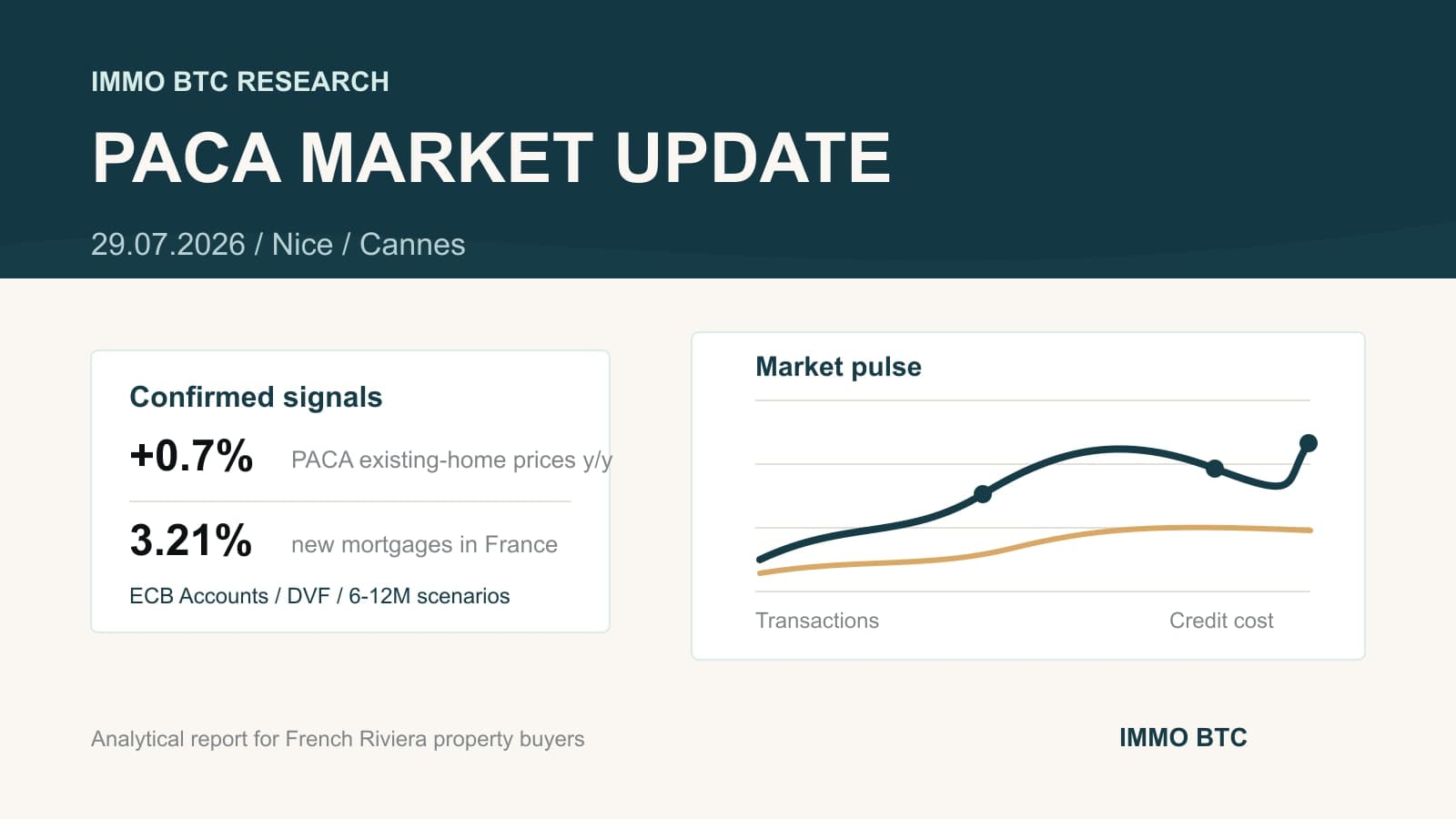
The September releases describe two different periods. Banque de France published July lending data on 7 September; INSEE published second-quarter resale housing figures on 8 September. They update the picture without directly measuring September’s market.
| Indicator | Latest observation | Comparison period |
|---|---|---|
| Average new housing loan rate, excluding renegotiations | 3.30% | July 2026; June: 3.27% |
| New housing lending, excluding renegotiations | €11.0bn | July 2026, seasonally adjusted; June: €13.2bn |
| Resale prices, France excluding Mayotte | −1.0% quarterly; −0.8% annually | Q2 2026 |
| Resale prices, PACA | −0.5% quarterly; +0.2% annually | Q2 2026 |
| Resale transactions, France excluding Mayotte | approximately 958,000 | 12 months to the end of June 2026 |
Sources: Banque de France, 7 September 2026; Insee / Notaires de France, 8 September 2026. The interest rate excludes fees and insurance and is not an individual loan’s TAEG. The latest observations are provisional; quarterly price changes are seasonally adjusted.
How trends differ between local markets
Nationally, annual apartment prices changed by −0.1%, compared with −1.3% for houses. This highlights a segment difference but does not establish a discount for a central Cannes apartment or an Antibes villa.
PACA combines a negative quarter with a small annual increase. These measures compare different starting points. An index is also distinct from the median asking price or the average transaction budget.
For four local towns, our DVF comparison of apartments and houses provides another perspective. It uses a different method and observation year, so it cannot replace this index.
Why first-quarter figures have changed
INSEE revised France’s first-quarter price change from +0.2% in the May release to −0.2% in September. Additional transactions and updated seasonal factors change estimates. The site’s July review should therefore be read as an archive of the information then available, with this article serving as the update.
A practical buying sequence
First, recalculate borrowing capacity with your lender. Then identify recent comparable sales matching location, property type, size and condition. Add renovation, shared building works, insurance and recurring ownership costs separately.
A higher monthly payment may reduce an affordable purchase budget. A lower national index does not oblige a seller to negotiate: comparable transactions and property-specific issues, including DPE, noise, floor level and legal restrictions, support the discussion.
Both sides benefit from considering price together with financing terms and completion timing. Broadly stable transaction numbers do not establish equal liquidity across market segments.
This review is not an individual valuation or investment recommendation. Average rates and indices do not guarantee transaction terms, and source data may be revised.
PACA apartments hold up better than houses
The Insee / Notaires de France table for Q2 2026 shows a regional difference:
| PACA property type | Quarter on quarter | Year on year |
|---|---|---|
| Apartments | −0.2% | +1.3% |
| Houses | −0.9% | −1.0% |
Source: 8 September release; latest observations are provisional and quarterly changes are seasonally adjusted. Annual apartment resilience coexists with a small quarterly decline. Both house comparisons are negative, weakening the case for a broad regional recovery without defining a discount on an individual villa.
Financing after the ECB’s 10 September decision is a separate consideration: July lending data cannot reflect that later decision.
Sources and verification date
Checked on 21 September 2026. Observation periods and limitations are identified in the article.