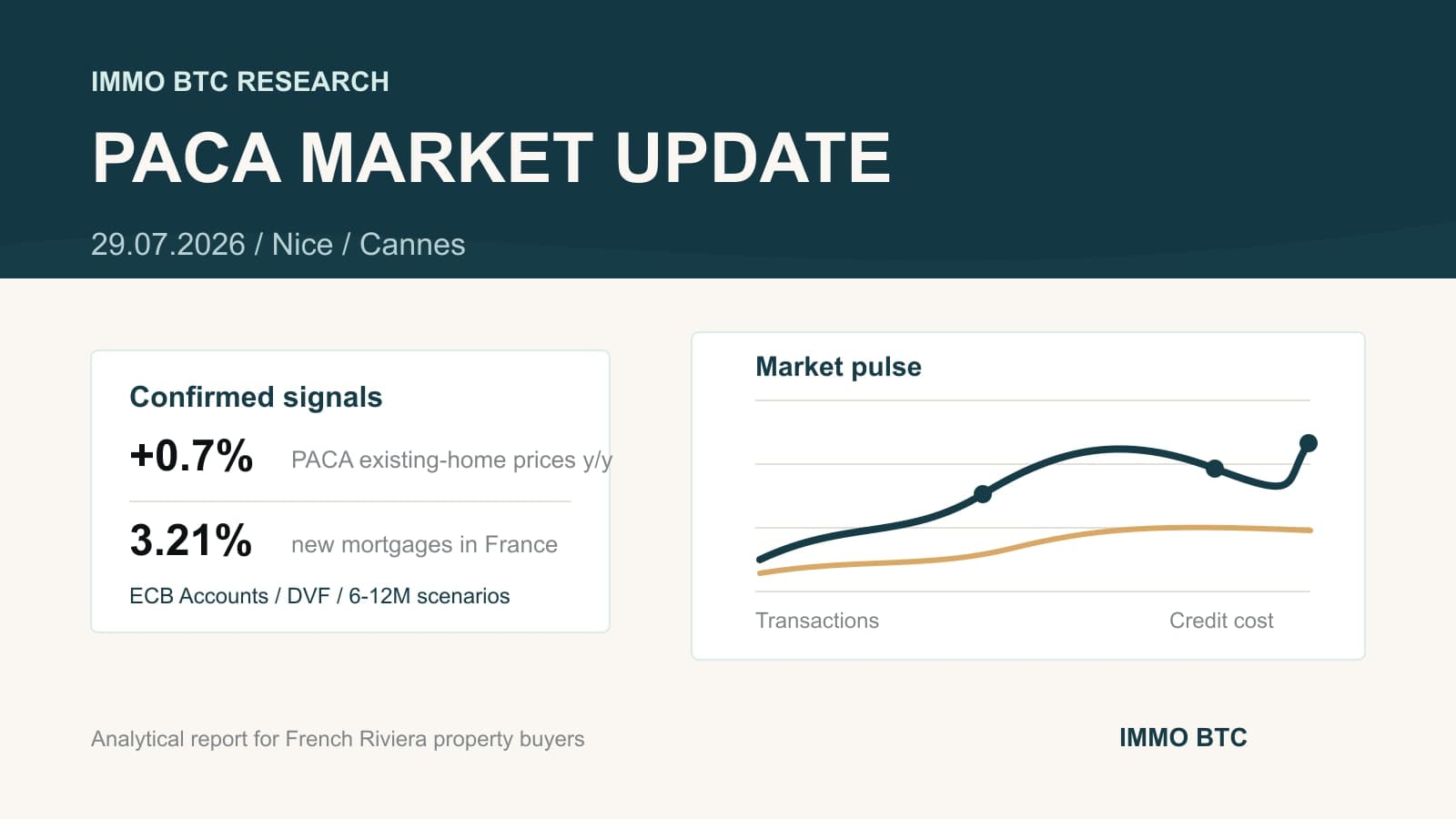
Update, 21 September 2026. The July situation discussed below reflects information available at that time. The ECB raised rates on 10 September, and new Insee data show falling PACA house prices in Q2. These updates change the earlier scenario.
What the document actually covers
On 27 August, the European Central Bank published its account of the meeting held on 22–23 July 2026. It explains an earlier decision; publication did not itself change policy rates. This follows our July PACA review. Current French lending figures are covered separately in the September update.
Members supported holding rates, but did not declare the tightening cycle over. The discussion retained the possibility of further tightening unless the inflation outlook improved significantly. At the same time, the ECB did not commit to a rise at its next meeting.
Three signals for a property purchase
| Signal in the account | Practical implication |
|---|---|
| The energy shock still creates uncertainty | Avoid relying on a single favourable financing scenario |
| Banks tightened mortgage credit standards in the second quarter | Check whether the bank accepts your borrower profile, as well as its advertised rate |
| Policy is reassessed against incoming evidence at each meeting | Separate your purchase timetable from expectations about the ECB |
These are our implications for buyers, not ECB forecasts for Nice or Cannes property prices. The account covers the euro area. Its mortgage figures must not be presented as French averages or quotes for non-resident borrowers.
Why a pause does not lock in your loan
A bank’s funding costs, the loan term, deposit, insurance, security and affordability assessment all sit between policy rates and a personal mortgage quote. Two loans with the same nominal rate can have different overall costs.
Compare TAEG, the annual percentage rate of charge, for the same amount and term. Review insurance exclusions, fees, security and early repayment conditions separately. If your income is in another currency, include currency exposure and documentary requirements in the review.
A change in ECB policy does not by itself alter the agreed interest rate on an existing fixed-rate mortgage. For a new purchase, the validity and conditions of the lender’s offer matter.
Before making an offer on a property
- Obtain an initial financing assessment stating the amount, term and documents required.
- Budget for acquisition costs, renovation and a liquidity reserve alongside the purchase price.
- Test less favourable financing terms and set your maximum property price.
- Agree the financing condition, or condition suspensive, with the notaire before signing the preliminary contract.
- Recalculate using the actual bank offer once a property has been selected.
For a cash buyer, the lending channel is less direct, but mortgage conditions can influence the future pool of purchasers. That supports a property-specific liquidity review; it does not establish a region-wide entitlement to a discount.
This is an analysis of an ECB discussion, not personal banking or investment advice. Check subsequent decisions and the specific loan terms at the time of your transaction.
Sources and verification date
Checked on 21 September 2026. Observation periods and limitations are identified in the article.