You have found an apartment on the French Riviera. The listing shows an energy rating, but that letter alone cannot tell you how comfortable the home will be or what works might cost. These questions will help you assess a property for your own use, occasional letting or primarily rental use.
This guide covers the condition of the home and its costs. For the transaction itself, see our guide to buying property in France; for legal checks, use the checklist before the preliminary contract.
What is a DPE, and what should I ask the seller for?
A DPE is France’s official home energy performance report, short for diagnostic de performance énergétique. A certified assessor prepares it. The letter from A to G in a listing is only a summary: A is the most efficient class and G the least efficient.
Ask for the apartment’s full DPE. Check its address, floor area, date, report number and equipment description against the property. Read the improvement recommendations and summer comfort information. Estimated costs assume standard use; they are a reference point, not a promise about your bills.
How to verify the report. If you already have it, open the official Service Public page for checking a DPE, select “Accéder à l’outil de recherche” (“Open the search tool”), then enter the DPE number in the ADEME service. Compare the address, date and energy rating in the record with the seller’s PDF. If the number is not found or the details differ, ask the seller or the assessor who prepared it for an explanation and an up-to-date document. Checking the record does not establish the apartment’s physical condition.
Check the validity period. DPE reports issued from 1 July 2021 are valid for ten years. Reports issued between 1 January 2018 and 30 June 2021 ceased to be valid on 1 January 2025; a new report is needed for a sale. If the report is older still, request a current assessment. Validity periods and conditions — Service Public.
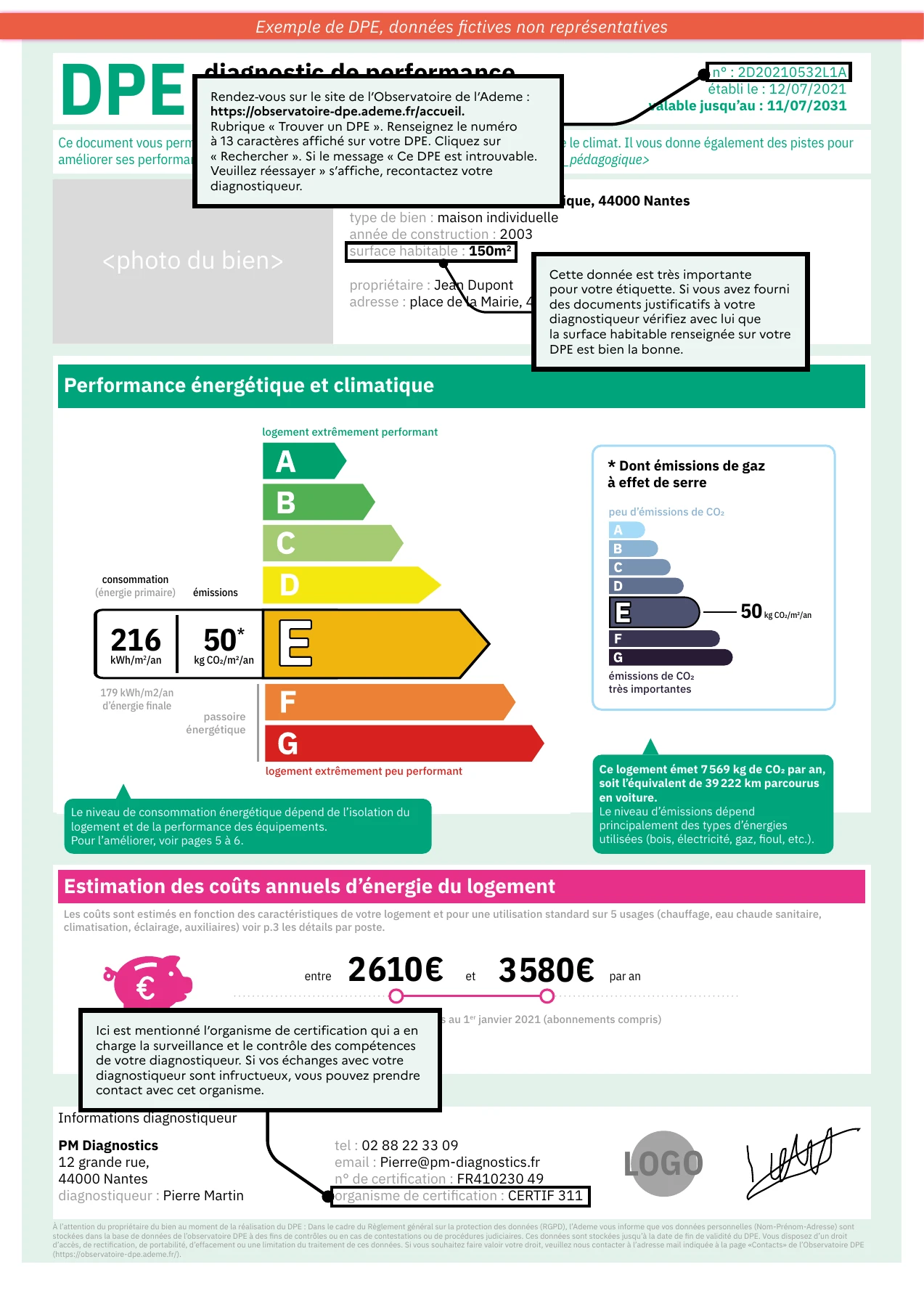
What a DPE looks like. A sample from the French ministry’s “Comprendre mon DPE” leaflet, December 2022 edition. The dark background overlay has been removed for readability; all data and annotations are unchanged. Its figures and dates are illustrative and do not apply to your purchase.
Open the large PDF. Ministry original, page 2. Source: Ministère de la Transition écologique, Licence Ouverte Etalab 2.0.
If the seller refers to an improved rating after recalculation, request the original report and the supporting certificate. Our news article on DPE changes in 2026–2027 explains the calculation changes and their dates.
A DPE, an energy audit and a technical inspection answer different questions:
| Check | What it gives the buyer |
|---|---|
| DPE | An energy rating and improvement recommendations; it is not a report on the property’s overall technical condition |
| Energy audit — audit énergétique | Energy renovation scenarios, estimated costs and expected performance; contractor quotes are needed to commission works |
| Technical inspection commissioned by the buyer | Checks of specific concerns: damp, cracks, roofing or equipment. Agree the scope and accessible areas with the specialist |
Selling an individual apartment in a copropriété does not trigger a mandatory energy audit solely because it is rated F/G. In mainland France, this obligation covers E-, F- or G-rated houses and residential buildings in single ownership. Audit scope and contents — Service Public.
Next question: what does the energy rating tell you about comfort?
Does a good rating guarantee a comfortable home?
No: the energy rating complements a viewing; it cannot replace it. Check shading, ventilation, noise with windows open, damp and the condition of heating or cooling equipment. On the Riviera, consider particularly the seasons when you intend to stay.
Read the seller’s bills alongside their pattern of use: whether they lived there all year, used air conditioning and heated every room. Your own costs may differ.
Hypothetical example: recalculation improves the rating, but the apartment is still on the top floor beneath the same roof. This does not establish that overheating has disappeared or that planned roof repairs are unnecessary. Check comfort during the viewing and building costs in the documents. What to check in summer.
A low rating also needs to be assessed alongside the necessary works. Next question: is an apartment with a low rating worth considering?
Should I rule out an apartment rated F or G?
The letter alone does not decide the purchase. You can consider the property if the necessary works, their feasibility, timing and total cost are understood. The possibility of buying and eligibility for future letting are separate checks.
Before deciding, consider four conditions:
- whether the apartment suits your intended use before works are complete;
- whether a specialist has assessed the technical solution and expected result;
- which works depend on co-owner decisions or permissions;
- whether the purchase, works and waiting period fit your budget and timetable.
If the plan depends on an unconfirmed permission, a promised rating improvement or unknown shared costs, resolve that uncertainty first. Compare available alternatives; a low rating alone does not establish that the price is attractive.
Next question: how do personal use and letting change the requirements?
What changes if I buy for myself or for letting?
The technical condition matters in every case; intended use changes the priorities.
- For yourself and your family: seasons of residence, quiet, bedrooms, cooling and whether you can manage the works period.
- Your own residence with occasional letting: also check whether your chosen rental use is allowed under municipal and building rules, the applicable energy requirements and arrangements for maintenance. For Nice, see our article on holiday letting.
- Primarily for letting: identify the rental type first. Long-term residential use and holiday stays require different checks. Confirm letting eligibility, when the apartment will be ready and costs while it is unoccupied.
Before forecasting income, confirm that the intended use is possible for this particular property.
Whatever the intended use, works to shared parts can add to the apartment’s costs. Next question: which building documents help establish costs?
Which building documents help establish future costs?
Assess costs within the apartment separately from those for shared parts. A copropriété is a building with jointly owned common parts; the syndic manages it. Ask the seller and managing agent for the documents relevant to the apartment and building:
| What to request | What to establish |
|---|---|
| General meeting minutes for the last three years | Works discussed and decisions taken |
| The seller’s regular and exceptional charges for the previous two accounting years | Actual costs and reasons for one-off payments |
| The works fund share attached to the apartment and latest contribution, where a fund exists | Money accumulated; this does not guarantee future works are covered |
| The works plan or draft and available building assessments | Shared areas requiring attention |
| Approved estimates, payment schedule and the apartment’s allocation | How much may be due, when and on what basis |
This is a working list for assessing costs. Confirm the full transaction pack with the notaire using Service Public’s guide to buying in a copropriété. Establish separately who pays specific calls for funds before and after completion.
Next question: how do you turn this information into a budget?
How can I prepare a works budget before deciding?
Separate acquisition costs, one-off works and recurring running costs. For each significant job, establish the estimate, decision-maker, permissions needed and a realistic timetable.
Replacing equipment inside the apartment and insulating a shared façade require different arrangements. Check permission requirements for windows, an external air-conditioning unit and sun protection in advance. Establish whether you can live in the apartment or let it during the works.
Mark unconfirmed amounts and decisions as open questions. If they materially affect the purchase, take them to the appropriate specialist and the notaire before committing. A general statement that renovation will improve the DPE does not replace an assessment of the technical result and cost.
Hypothetical budget for a limited scope of works in an F/G-rated apartment. Every amount below is invented to explain the calculation: these are not market rates, a quotation or a client case. Assume €12,000 for works inside the apartment and €80,000 for shared works, including taxes. Under the assumed allocation key for those specific shared works, the apartment accounts for 50 shares out of 1,000: 80,000 × 50 / 1,000 = €4,000.
| Item in the hypothetical budget | Amount |
|---|---|
| Works inside the apartment, including taxes | €12,000 |
| Apartment’s share of common works | €4,000 |
| Contingency allowance chosen for this example | €2,000 |
| Total for works and contingency | €18,000 |
Calculation: 12,000 + 4,000 + 2,000 = €18,000. The example assigns the full share of common works to the buyer and assumes no grants or offset from the works fund. The contingency is an assumption, not an amount sufficient for every property.
To verify a budget for your apartment, replace the assumptions with tax-inclusive contractor quotes, the approved building works estimate and the managing agent’s calculation using the applicable allocation key. Check the payment schedule, use of the works fund and allocation of costs between seller and buyer. Add works, notaire and other transaction costs, financing and any temporary accommodation to the acquisition price; calculate recurring running costs separately. This calculation does not establish the future energy rating: a specialist must assess the proposed works.
Next question: how do you compare the apartment with an alternative?
How do I compare two apartments?
Compare the same intended use over the same ownership period. Use the table below for two actual properties. “To confirm” means unknown, not zero cost. The hypothetical €18,000 must not be carried over automatically into either column.
| What to compare | Apartment A plus works | Available apartment B |
|---|---|---|
| Price and transaction costs | To confirm | To confirm |
| Works inside the apartment, including taxes | Obtain quotes; currently unknown | Obtain quotes; currently unknown |
| Share of common works | Managing agent’s calculation; to confirm | Managing agent’s calculation; to confirm |
| Readiness date and permissions | To confirm | To confirm |
| Personal use or chosen rental use | Confirm eligibility and readiness | Confirm eligibility and readiness |
| Costs while waiting and recurring running costs — separately | To confirm | To confirm |
Keep the supporting document and date alongside each confirmed amount; mark works that have not been approved separately. A renovated alternative may still incur future building costs. While significant amounts or dates remain unknown, you cannot conclude which purchase will cost less.
Next question: how can you begin comparing with IMMO BTC, including before travelling?
How do I start a conversation about an apartment?
Which checks are needed for the apartment you have found? Send us the listing link and briefly tell us how you plan to use the property and what questions you have. Together, we can identify which documents need clarification, where a specialist’s assessment is needed and where to start. We can discuss the information you already have during our conversation.
You can contact us before approaching the selling agency, after an exchange or after a viewing. There is no need to read every guide or collect a full document pack first. We will agree on the scope of further support during our conversation and discuss alternative apartments if useful.
If you are still abroad, preparation begins with that conversation:
- We identify the documents to request from the seller and managing agent: the full energy report, building decisions and cost calculations. You can send any documents you already have.
- We identify unclear findings, estimates and decisions, then agree which questions to ask and which answers to obtain in writing before you travel.
- If there is a significant technical concern, we agree on involving an appropriate specialist: what to inspect on site, which areas are accessible and what written findings are needed — problems identified, inspection limitations and recommendations.
Reading or translating PDFs and reviewing photographs cannot replace an inspection. Access dates, seller responses and the specialist’s schedule need to be confirmed separately; you do not need to gather everything yourself before contacting us.
Contact us on WhatsApp, email info@immobtc.com or call +33663567065.
Sources and currency
Checked on 22 September 2026. Requirements for a particular apartment depend on its documents, intended use and the rules in force at the time of the transaction.
- Service Public — DPE contents and verification.
- Service Public / ADEME — check a DPE and obtain a certificate.
- Service Public — documents when buying in a copropriété.
- French ministry — DPE information and explanatory resources.
For the next stage, see the guide to the buying process.