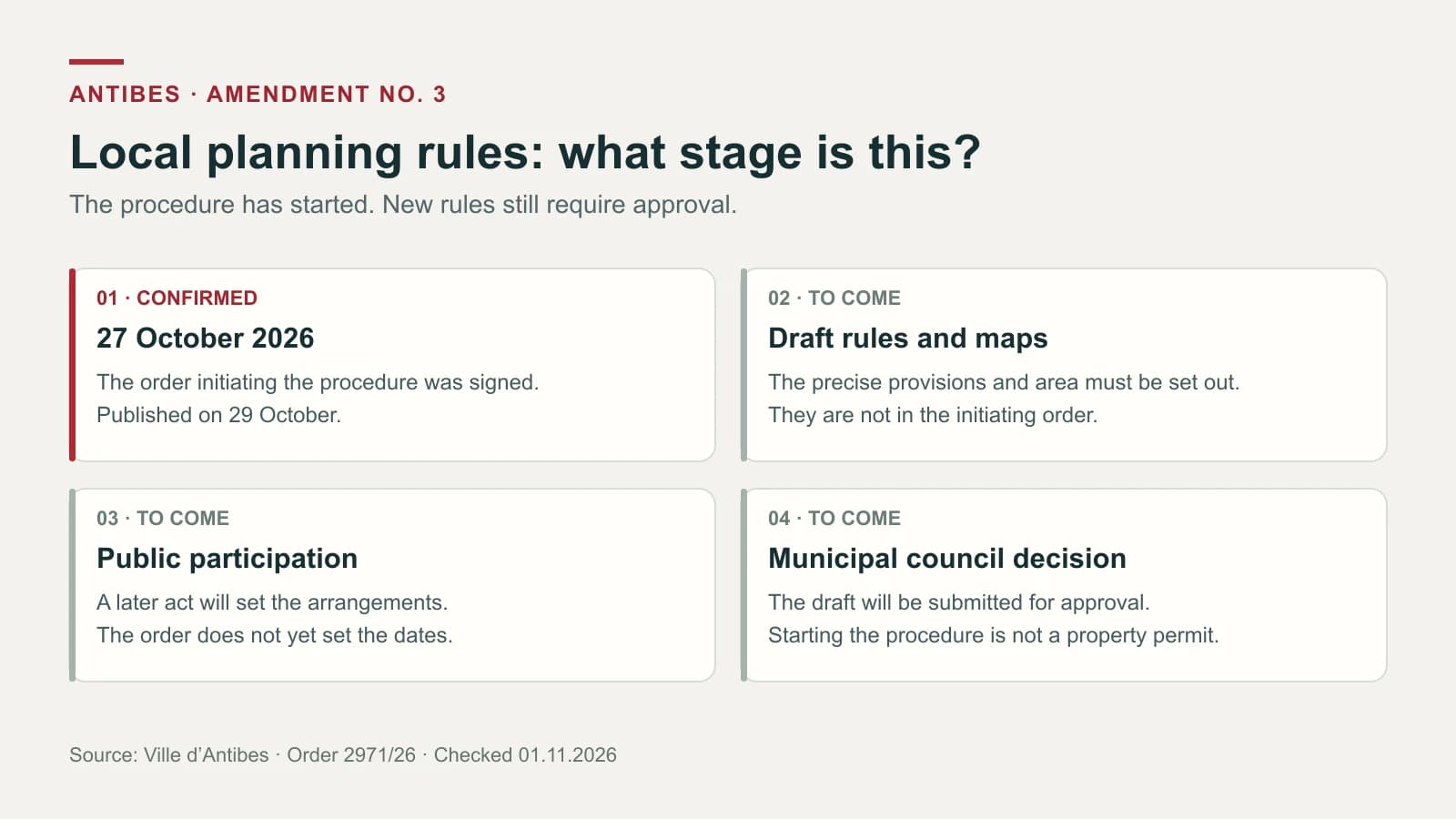
Antibes has started preparing an amendment to its local land-use plan. The order was signed on 27 October and published on 29 October 2026. The municipality intends to revise social housing rules and the business use of existing buildings in part of a protected natural zone. For an apartment or villa buyer, this is a reason to check a proposed project against current documents; the order has not yet changed the permitted options for a particular property.
What should you check before buying an apartment or villa in Antibes if you plan work or a new use?
Before buying property in Antibes, compare the exact plot, the building’s lawful planning use, the current planning rules and your proposed work or use. Request documents for previous alterations and permissions. If the project’s feasibility determines your purchase decision, establish the evidence needed with an architect, the planning department and the notaire, the French legal professional handling the sale, before committing.
Begin by describing the result you want: living in the property without alterations, extending the house, changing its rooms or using the building for a particular activity. Then gather the address and cadastral information, plans, the seller’s documents for the existing building, previous permissions and records of completed work.
Compare these with the plot’s zone and restrictions. For an apartment, include the co-ownership documents: decisions affecting shared parts and the building’s rules may matter to the project independently of the local land-use plan.
If the evidence is sufficient, you can refine the cost estimate, sequence and timetable for the work. If important documents are missing, first establish what must be obtained and who can confirm the findings. If the proposed use does not fit the current rules, review the project or property choice. A hoped-for future amendment cannot be relied on as an existing permission.
Where the ability to carry out work determines the purpose of the purchase, discuss with the notaire, the legal professional handling the sale, which checks and conditions should precede your commitment and how the dependencies should be recorded in the sale documents. There is no single wording suitable for every property.
How can you find an Antibes property’s planning zone on the official map?
Find the plot by address on the official Géoportail de l’urbanisme map and read its zone designation; a separate cadastral search form is also available. Compare the zone with the written rules and confirm the documents’ date and applicability with the planning department: the map does not itself authorise work or a new use.
Open the official Antibes map with address search. The step-by-step guide to finding an Antibes plot by address explains how to locate the property, plot and zone designation.
The municipality’s mapping-service page links to interactive maps and plot information. Check the main zone and the restrictions shown over it, including natural risks, heritage protection, rights or restrictions affecting the plot and any other designations relevant to your project. Na does not cover the whole of Cap d’Antibes.
The municipality also provides these sheets on its page for the current land-use plan:
| Official document | What to use it for |
|---|---|
| General zoning plan, sheet 5 | Locate the relevant sector and choose a detailed sheet. |
| Social housing mix plan, sheet 5P | Check the marked areas to which social housing provisions relate. |
| Cap d’Antibes — Garoupe, sheet 5M | Read the zoning designations for this part of the cape. |
| Cap d’Antibes — South, sheet 5N | Read the zoning designations for the southern part of the cape. |
These links open the official originals. The downloaded sheets list amendments up to 17 February 2023, while the linked written rules carry the edition date 22 December 2025. The municipality continues to offer these sheets in its current document set; confirm which map and written rules apply to the chosen plot. A small JPG is no substitute for a detailed sheet or advice from the department.
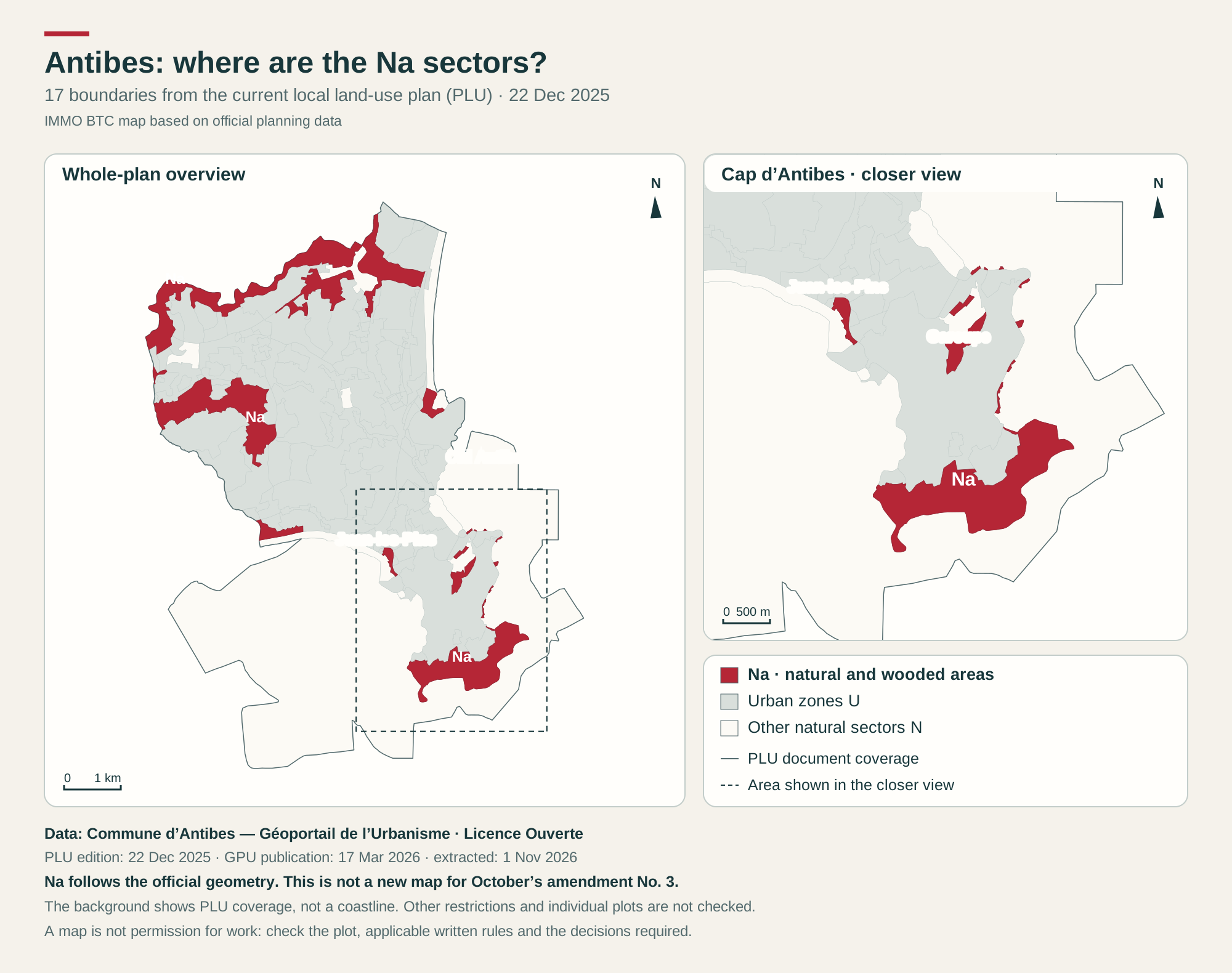
The maps above show existing zoning. The order of 27 October does not contain a new map for amendment No. 3.
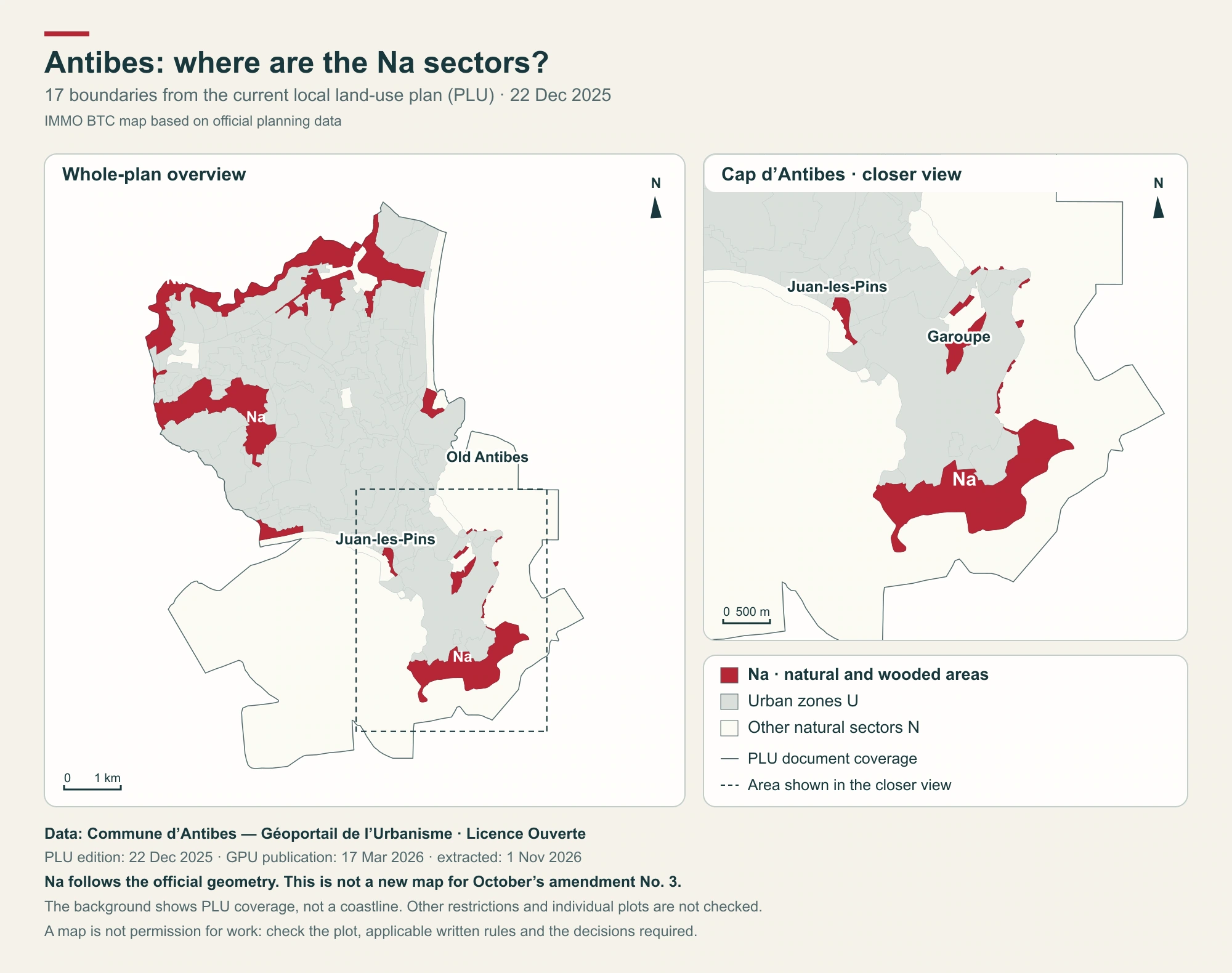
Na sectors are red, using official digital data from the planning document dated 22 December 2025, extracted on 1 November 2026. Urban U zones are grey; other natural N sectors are light. The outer line shows the document’s coverage, including marine areas, rather than a coastline. This map shows existing zones, not October’s draft amendment No. 3; other restrictions and individual plots have not been checked here.
Data: Commune d’Antibes — Géoportail de l’urbanisme; original IMMO BTC map. Official digital planning document. Data reuse conditions.
Keep the cadastral reference, zone code and documents you read. Continue with the detailed guide to current Na rules and plot checks in Antibes: it explains the difference between planning floor area and building footprint, height and upward-extension restrictions, and which documents to check for the chosen property.
If you are unsure how the markings on Antibes’ map relate to your chosen property, you can ask IMMO BTC. Share the address or listing and explain what you want to check; we can help identify the plot information and documents needed for the next checks.
Does Antibes’ planning amendment No. 3, started on 27 October 2026, already allow business use of buildings in the protected natural sector Na?
Antibes’ order of 27 October 2026 does not authorise a business conversion: it starts work on rules for existing buildings in Na, a protected natural sector. Whether a particular use is possible must be checked against the current documents for the plot and building. The order does not specify the future permitted activities or conditions.
Under the current written rules, Na is part of protected natural zone N. Prohibitions apply, with specified uses allowed subject to conditions. For example, article N 2.1 addresses extensions to existing homes without changing their planning use, and ancillary buildings, provided the stated requirements are met. This is not a general permission to convert buildings for business use.
If you are buying a building for a new activity, establish its lawful planning use, the plot’s zone and the scope of your project. An architect and the municipal planning department assess the applicable restrictions and permissions needed. A notaire, the legal professional handling the sale, or a lawyer checks what the project means for the purchase terms.
The October order does not establish permission to operate a hotel, restaurant, office or short-term rental in your chosen building. A building’s planning use and the rules for letting it require separate checks.
Current written rules: articles N 1–N 2, printed pages 132–134.
The order of 27 October 2026 does not announce additional storeys in Na. Preparing rules for business use of existing buildings does not itself remove the current ban on raising existing buildings in article N10.2. Any new proposal must be assessed in the published draft and according to its status; the initiating order alone is no basis for relying on an extra storey.
Start with the address or cadastral reference, the plot number, so that the zone, building documents and intended activity can be considered together.
Are you considering a building in Antibes’ Na sector for a particular business? You can discuss the property and intended use with IMMO BTC. A listing and a short description of your idea are enough to start identifying the documents and questions for the relevant professionals.
Does planning information replace permission to carry out work in Antibes?
Municipal plot information and a French planning certificate help establish the rules and assess a project, but they do not replace permission to carry out work. For a proposed project in Antibes, establish the applicable procedure separately and obtain the necessary decisions before work begins.
The municipality expressly describes its mapping information and plot notes as informational. If you have a defined project, you can discuss a project-specific planning certificate, the certificat d’urbanisme opérationnel, with the planning department. It indicates whether the described project is feasible on the plot; it is not a building permit.
Service Public: types and purpose of planning certificates. The work proposed, the property and its location determine which further procedure must be considered.
See the detailed guide on certificate protection and when a decision may be postponed.
Give the professional a description of the specific project together with the plot documents. A colour on a map cannot provide the complete answer.
If you have planning information for a property in Antibes but are unsure what else is needed to assess your plans, you can discuss it with IMMO BTC. Start by identifying the property and describing the work; we can help prepare questions for the planning department or the relevant professional.
If you have chosen an apartment or villa in Antibes, you can discuss where to start the checks before buying with IMMO BTC. Send the listing and describe your intended work or use; we can help identify the documents to request and the professionals to involve.
Which local planning rules is Antibes preparing to change in October 2026?
Antibes has started preparing amendment No. 3 to its local land-use plan. Its announced aims are to revise social housing rules while retaining the 40% target, and to prepare rules for changing the planning use of existing buildings for business purposes in Na, a protected natural sector. The order has not yet approved new rules.
Mayoral order No. 2971/26 was signed on 27 October and published on 29 October 2026. The local land-use plan, called the plan local d’urbanisme in French, combines written rules with maps showing where construction and building uses are allowed and under which conditions. The proposed amendments will affect both parts.
For social housing, the municipality intends to make the allocation between funding categories more flexible. For existing buildings in Na, it will prepare provisions on changing their planning use for business purposes. The order does not list newly permitted activities, specific buildings or final conditions.
What does the 40% social housing target mean when buying property in Antibes?
Antibes’ October 2026 order retains a 40% social housing target while amendments are prepared; it does not introduce a new duty for every apartment buyer. The current requirements apply to particular projects and areas. A project to build or convert a building into several homes needs a check of the zone, map, size and operation as a whole.
For example, article UB 2.5 of the current rules requires at least 40% social rented housing in the affected multi-unit housing projects, whether newly built or created through a change of planning use, when either threshold is reached: 12 homes or 1,000 m² of floor area allocated to housing, calculated under planning rules (surface de plancher). This is a specific planning measure, not the area of the rooms or the floor area stated in a property listing.
Application depends on the map and the full provision, including exceptions and how an operation is assessed when a plot is divided. Additional requirements may apply within marked areas. These example thresholds do not replace an assessment of a particular project.
The rules differ between sectors. Article UE 2.4 specifies 40% for UEa, UEc and UEd, but 35% for UEb. The target in the order therefore cannot be treated as a single proportion applying throughout the municipality.
The proposed easing concerns the allocation between funding programmes for the social housing component. The order does not yet set out new proportions or the amendments’ final scope. It also imposes no separate payment on a buyer of an existing apartment.
In certain mapped areas, the rules also require a separate minimum of 10% of planning floor area for social or regulated home ownership. This requirement has its own calculation basis and conditions. It cannot simply be added to the 40% and described as “50% of the homes”.
Current written rules: UB 2.5–2.6, pages 48–49; UE 2.4–2.5, pages 88–89.
A threshold in this example does not establish exemption from every other requirement. Alongside the written rules and map, check applicable planning and development orientations where they exist. Article L152-1 distinguishes compliance with the regulation from compatibility with those orientations; they are neither irrelevant nor an automatic override of all other rules.
If your purchase involves creating several homes, ask an architect to assess the whole operation, rather than only the proposed size of one lot.
Are you considering a purchase involving subdivision of a building or the creation of several homes in Antibes? Tell IMMO BTC which property you are considering and how many homes you have in mind; we can help gather the starting information and coordinate a discussion with an architect.
Does the social-housing share predict higher prices for private apartments in Antibes?
No. The social-housing share, or the start of changes to its funding, does not by itself predict the price of a private apartment in Antibes. The order neither quantifies that effect nor sets new funding proportions.
A programme’s economics need separate evidence about land, construction, funding, housing mix and agreed prices. A possible cost-allocation mechanism proves neither the amount nor its transfer to a buyer. Distinguish project obligations from the municipality’s social-housing stock, and new development from resale. The different bases for 40% and the separate 10% do not create a price formula. Municipal housing-policy information is not a price forecast.
If you are comparing a new development with an existing Antibes apartment, send the options to IMMO BTC. We can help separate confirmed prices and costs from market assumptions.
The practical next question is which current rules apply to your chosen property and intended use.
If news of the planning amendment has raised doubts about an apartment or villa in Antibes, you can discuss the situation with IMMO BTC. Send the listing and explain which plans concern you; we can help identify what to check using the documents currently applicable to the property.
When will Antibes’ local planning amendment No. 3, started on 27 October 2026, take effect, and how can the public participate?
The order of 27 October 2026 gives no date for amendment No. 3 to Antibes’ local land-use plan to take effect. A later act will set the precise arrangements for public participation. Following preparation, the necessary consultations and consideration of comments, the draft must be submitted to the municipal council for approval.
The order provides for preparation and justification of the project, a decision on whether an environmental assessment is required, notification and consultation of the relevant bodies, and public participation. Article 6 leaves the specific participation arrangements to a later announcement.
Look for official documents concerning amendment No. 3, how to access the project and how to submit comments. The procedural order taking effect does not mean the new planning rules have been adopted.
Official order: articles 3–9. Until the next document is published, we have no confirmed timetable for completing this procedure.
How does amendment No. 3 to Antibes’ local land-use plan, started on 27 October 2026, differ from the review started in May 2026?
Review No. 2 and amendment No. 3 concern Antibes’ local land-use plan but are separate procedures. The municipality describes the review initiated by the council on 7 May 2026, with broader aims. Amendment No. 3 starts with the mayoral order of 27 October 2026. The participation arrangements and dates for one procedure cannot automatically be applied to the other.
On its page about the plan under review, the municipality discusses greening, restoring the soil’s natural functions, limiting impermeable surfaces, adapting to heat and water runoff, and housing construction.
This is the municipal page’s description of the May review. It does not establish new restrictions on a particular villa through the October order. When contacting the municipal department, identify the procedure and provide the plot documents so that the response addresses the right question.
Starting these procedures does not itself mean that the current planning documents have immediately been replaced. For a project, have the applicable rules and relevant procedures checked with the municipal department.
For a purchase decision, compare the current documents with the procedures relevant to the property. A broad environmental aim does not replace a check of the specific project.
If the documents for your chosen property in Antibes refer to different planning procedures, IMMO BTC can help coordinate a review with the relevant professionals. Send the property link and tell us which amendment or part of your plans is unclear to begin a specific discussion.
The next substantive information will be the draft text and maps, a public-participation announcement or an approval decision. Each document should be read according to its actual status.
If the timing of your purchase or work in Antibes depends on this procedure, you can discuss that dependency with IMMO BTC. Tell us which property and deadline matter to you; we can help prepare questions about the current status of the documents for the municipality and the professionals handling the purchase.
After checking the planning possibilities, the next question is how to check the documents, alterations and condition of a property you have already found in France. The guide helps organise checks before a purchase decision. If you are considering a particular apartment or villa in Antibes, a listing and a description of how you want to use it are enough to start the discussion.
Sources and review date
Checked on 1 November 2026. The order was signed on 27 October and published on 29 October. Its relevance to a particular plot and project requires the property documents and checks by the appropriate professionals.